Wednesday, 25 February 2015

Delayed Onset Muscle Soreness...I bet you've felt it!!

You had a great training session, worked hard and your muscles are feeling nice and tired, but that's about it.  You wake up the next day, and the feeling is a little different.  Your muscles feel tight and pretty sore, but bearable, as you think..."at least I can move".  You get a good a good rest that night and wake up the following morning and the "pretty sore" feeling is no longer there.  The pretty sore has turned into excruciating pain!!  Your bedroom is upstairs, which means that you need to go down the stairs to start your day and oh, the pain of walking down the stairs.  You think, "I can't move, what did I do to deserve such agony?" Great training session now, eh?


This feeling is the muscle soreness called delayed onset muscle soreness (DOMS).  It doesn't come right after you workout, but 24-72 hours later.  It's thought to be a result of little tears in your muscles (which, over time, will repair and leave yourself feeling stronger).  Some people realize the need for a little pain and like the feeling.  Others avoid it at all cost.  Getting a better understanding of DOMS will allow you to better prepare for it, avoid it if you need to and recover from it if the feeling is there.  So, let's take a look at DOMS a little closer to help you in the future.

What can cause such pain?  Well, it's the length of you workout, the intensity of you workout and the exercise selection of your workout...with the most emphasis on exercise selection.  You see, it's the eccentric motion that causes the majority of the problem.  That is, it's the part of the exercise where the muscle lengthens.  Usually, its the downward part of the exercise and in most cases the easiest part.  When you're running down hill and the downward motion of a squat or push-up are all eccentric.  A little note here, however, is that you are roughly 40% stronger on the eccentric motion.  Which means that while avoiding the eccentric parts of the exercise might relieve a bit of soreness, it's hard to make real strength gains without it.

And what about recovery? You've embraced the feeling you'll get when you enter a new phase of your program and start lifting heavy weight, with new exercises. Or maybe, you haven't embraced it...and just have a mean trainer, lol!! Whatever the case, you might want to alleviate some of that pain.  What are your options?  That debate is ongoing.  But before I give you some methods of temporary relief, know that in reality, I follow two methods....1. Go easy and work your way up or 2. Suck it up, lol!!
If you still need another way to get rid of soreness, some of the methods that people say have worked for them are:

- foam rolling
- gentle stretching

- rest & recover
- ice bath
- Aspirin, ibuprofen, or other non-steriodal anti-
   immflamatory
- sports massage
- Yoga

DOMS are an almost necessary part of any training regimen.  If you are new to working out, change your program, increase the weight or just use different muscles that you haven't used before, you will experience DOMS.  You will recover and you will feel better, next time you work out!!

Thursday, 19 February 2015

Physical testing....do you do it?

I just finished testing a young Junior A hockey player, so I can  better develop his off season training program. The testing for him is a little more involved than for regular non-athlete individuals, who aren't training in a particular sport. The tests involve a movement screen to test asymmetries and imbalances, power tests, strength tests, speed tests and endurance tests. But the same value comes from tests as the tests from non-athletes. 

There are many different tests, from the bench press test, which tests for upper body strength and is popular in different combines such as the NFL to the good ol' step test, which tests the cardiovascular system. To me (other than the tests which screen for health concerns) there are two main reasons why testing is important for both the trainer and the client. 
The first main reason is that testing gives a good and measurable baseline. It gives you something to go by so you can see either improvement or regression. How important is it to see the two months of training you've out in has made a difference? Very important to both the trainer and the athlete. To see that you are stronger, faster, have lost weight or dropped body fat. Or maybe you've been tested at the beginning if the season and at the end of the season, at which point you notice that you have developed many imbalances that need to be fixed.   


The second important reason is so that a proper training program can be developed to suit you. Whether you are an athlete looking to gain strength or a non-athlete looking to lose weight, you need to develop the proper program. An athlete who had great vertical jump testing, but less than adequate scores on the endurance test, might focus on conditioning and cardiovascular activity.  And as mentioned above, you might have developed certain imbalances and getting the proper program will fix those imbalances, whether you just finished tennis season and have a much stronger dominant arm, or finished golf season and have developed poor rotary stability in one direction.


I will close by saying that as important as it is to test, it is equally important to use the tests effectively. Whether it's developing programs or studying the improvements, tests are done for a reason. Just like in school, tests are a measure of what you learned, you need physical tests for any of the reasons mentioned above. Too many times testing  is done just to test.  You are testing or getting tested for a reason.  The results  from your test need to be used and should be used in ways to benefit both the trainer and client!!


Tuesday, 10 February 2015

How do you start your training session or your game?


Well, it's game time.  You show up to the rink in time
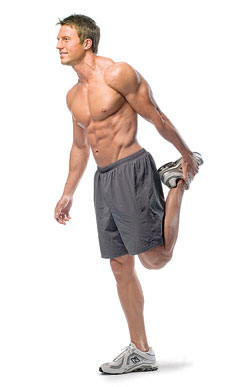
Warm Up Activities and Stretching Exercises
to get ready, and hit the ice in time for opening face-off.  Doesn't seem quite right, does it?  What about training? You go to the gym, get changed, go to the squat rack, load the bar with 250lbs and start squatting.  That doesn't seem quite right, either.  What am I missing?  For me, it's quite obvious, but for others, it may not jump out at them.  I think each situation would become a little more complete if I mentioned some sort of warm-up.  Your warm-up, whether it's before a game or training session prepares you for what's at hand, both physically and mentally.

Let's first take a look at the physical side of things and what the warm-up does.  Blood flow, central nervous system, body temperature, heart rate and more are just some of the things affected with a proper warm-up.  By doing a general warm-up you are able to increase blood flow and get the heart rate up, which if you've warmed-up properly before, will get a light sweat on you.  Things like skipping, or light jogging for about 5 minutes is usually sufficient.

You will then do a more specific part of your warm-up, doing movements and involving the muscles that will be used during your game or workout session.  Maybe you're warming up for a lacrosse game, where you would incorporate side shuffles, Carioca, arm/leg swings and more movements that are used during a game.  Or you could be just warming up for a nice workout session where squats, lunges and push-ups would be good.  Whatever the case, getting the muscles primed for use should be a top priority of any athlete.
Next, let's take a look at how the mental aspect is affected with a good warm-up.  Mental preparation for events is a topic that needs it's own post, but for warm-up the mental part is key.  In any sporting event, just thinking about what you are going to do and what you want to accomplish, gets you in the game.  When you get a good warm-up, you are spending time thinking about the exact movements, defending, moving around opponents and more.  You are putting yourself in the game or match.

Warm-ups are important for any sporting event and any workout session.  Like I said above, it get your muscles primed for the upcoming tasks, but it also puts you in the right frame of mind.  While doing your warm-up you aren't thinking about what a great day it is outside, or what your friends are up to.  You are thinking about the game, thinking about the match, thinking about what exercises you're about to do.  Next time you're at your game or workout session, get a good warm-up...it will do a long way into a great performance.

Wednesday, 4 February 2015

Skill Transfer

I was just going over some of the articles I kept from the Motor Control class I took when doing my Master's a few years back and one of the articles that popped out was one on skill transfer.  For example, does the training an athlete does to work on foot speed transfer smoothly into the sport they are training for? Or, how does learning one skill transfer into learning a similar skill?  Let's take a look at both those examples to see what they mean from a training perspective.

First, we'll take a look at how learning a skill transfers into learning a new skill.  Let's take throwing.  It has been shown that you should first learn to throw correctly overhand, before learning a different technique, such as hitting a tennis ball overhand.   Many young children are put into tennis programs and being taught the overhand serve/volley, without even learning how to properly throw.  When you look at the actions of both the overhand throw and the overhand serve you will see the similarities.  Both involve weight transfer in the direction of a target, hip extension, and so on.  You can see how the skills learned in throwing can transfer quite seamlessly to the skills of an overhand serve in tennis.  And this can relate to more fundamental motor patterns such as running and jumping, which should be learned before more complex movements are taught.


For training, what exactly does this mean.  First, you need to make sure you cover the basics.  Take youth training.  Training for youth should cover running, jumping, kicking, etc. before the more complex movements take place.  When kids have the fundamentals, then the skills learned will be transferred a lot easier into the more sport specific movements.  Seems simple.  But this goes for older athletes as well, not just youth. Learn to squat before you learn to jump.  Learn to throw before you learn to learn to hit a volleyball.

And second we can look at how skills transfer from training into sport.  I will take hockey for my example here.  I take hockey because it's played on skates and much of the training is done, well, not on skates.  So, you would tend to think that training transfer might no be very good when taking what you learned on the ground to the ice.  But the transferability is still quite high from training to the sport.  Much of the off-ice training transfer quite well to movements on the ice.  I was training a young hockey player the other day and we were going over the cross-over start, foot positioning and body position. This was not done on the ice, but it has been shown that certain movements transfer well from off-ice training to on-ice game situations.  The trick is being able to decide and distinguish what movements can transfer well.  The more similar the movement to the skill of the sport, the easier the transfer.

A full body rotational power exercise.


This doesn't mean that all training should look like the sport you are playing.  You still need to get strong, get fast and get powerful.  It just means that certain aspects of training can transfer nicely into game situations.